Rain Pavilion
Records Under the Lamp · Chapter 1 of 100
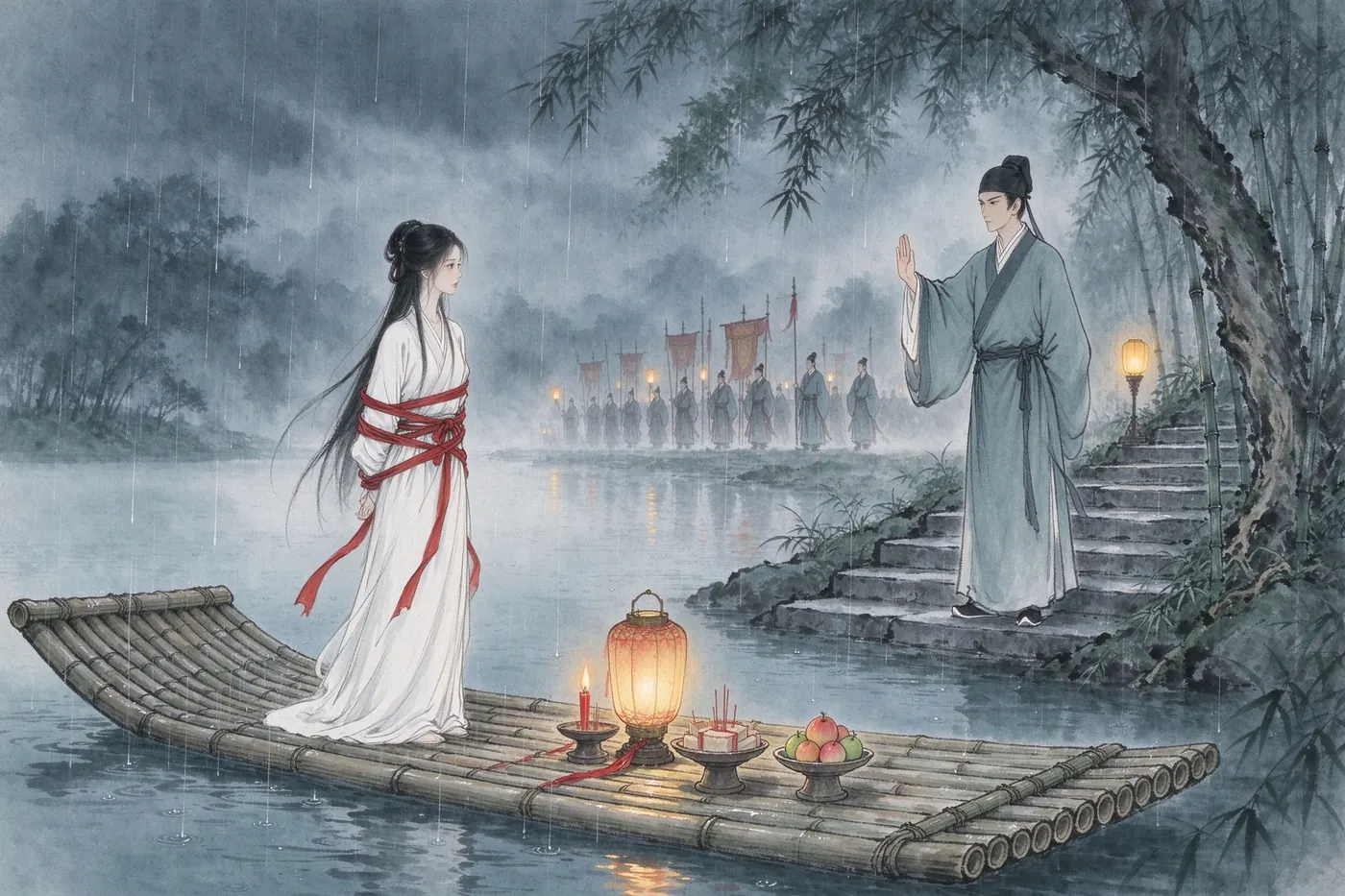
The rain had not stopped since afternoon.
Jiangnan's plum rains are sticky—they never fall through, and they never let up. The sky was like a wad of old cotton soaked in water, pressing low over the lake, pressing until the distant hills were no more than a pale blue shadow. Gutter-water hung down thread by thread, striking the bluestone pavement and splashing up small white flowers; the flowers bloomed and died, died and bloomed, shattering a whole day into pieces.
By the time Shen Zhibai reached the lakeside ferry crossing, the hem of his robe was already wet.
At the crossing stood a thatched shed, roofed with reeds, weathered by long years; a dark green moss had formed on the reed stalks, and the rain ran down the reed leaves, hanging along the eaves in a thin, sparse curtain. He took his stand beneath the shed and reached out a hand to test it; beyond the curtain the lake was a blur of grey, so that even the sky could not be told apart.
Inside the shed crouched an old boatman, a straw rain-cape over his shoulders, head bowed over a torn fishing net he was mending. The mesh was very wide; when his fingers passed through the holes you could see the blue veins rising on the back of his hand.
"Old sir," Shen Zhibai said, saluting with cupped hands, "when does one cross the lake today?"
The boatman did not look up; he waved a hand. "Not today."
"Why not today?"
"Rain's heavy." The boatman's answer was short, short as if driving someone off.
Shen Zhibai did not go. He stood another quarter-hour under the eaves, watching the rain show no sign of letting up at all, while the lake crept inch by inch up the foot of the dike. From his sleeve he drew out a few dozen copper coins and set them on the wooden block where the boatman mended his net.
"Old sir, I'll add to the fare. Take me across."
Only then did the boatman raise his face. It was a face wrinkled by lake wind, the creases packed with a mud-colour that could not be washed away. He glanced at the money on the block, then at Shen Zhibai's blue gown, washed so often it had gone white, and his expression suddenly darkened, as though some taboo had been touched.
"It's the god's day. Who dares ferry?" The boatman pushed the money back, pushed hard, so the coins rolled twice along the block. "No amount of silver buys back a life."
Shen Zhibai started. "What god's day?"
The boatman did not answer; he only thrust his chin toward the middle of the lake, rose, and went off into the depths of the shed, as if hiding from something.
Shen Zhibai stood where he was and asked no more.
He had spent half a year copying accounts for a family in the neighbouring town; if he had learned nothing else, he had learned this one thing: what a man will not say, asking a second time is wasted breath. He did not go to pick up the money—coins dropped in wet mud, brought back, would only carry ill luck; better to leave them for the next person sheltering from the rain. He stored the remark in his heart; this time—the third—he simply would not wait. He gathered himself under the small dry patch beneath his umbrella's rim, let the rain wet one half of his shoulder, and, treading the mud, went into the pavilion by the lake.
The pavilion was not large, and it was long since crowded with people.
A dozen or so villagers huddled under the pillars, no one speaking, only the sound of rain. A woman holding a child pressed the child's face into her own bosom, as if pressing something she feared to let see the light; two vegetable peddlers squatted in a corner of the pavilion, their loads of greens covered with a ragged cloth, the tips of the leaves still dripping; a man in black constable's garb leaned on the railing, his eyes constantly sliding toward the lake—a glance, then back, then another glance.
Only after Shen Zhibai had taken his place did he slowly sense that something about this pavilion was off.
A dozen people crowded together ought to make some stir—coughing, stamping feet, cursing the sky; there should be a sound or two at the least. But in this pavilion there was none. No one looked at this stranger; no one called him over to shelter from the rain; no one even sighed. Every face was turned toward the far side of the lake, every ear pricked up, as if waiting for a sound no one wanted to be the first to hear.
He gave no sign; he set his umbrella against the wall.
Shen Zhibai shook the water from his lapels and shifted half a step in, the mud on his soles scraping a faint line across the bluestone brick.
Just then he heard an old woman say, in a voice pressed low:
"...Sending another one."
"Sending who?" someone asked. A younger voice, its tail trembling, as though it had heard something of this somewhere and dared not hear it.
"One for the one in the lake." The old woman's voice dropped lower, so low it was almost swallowed by the rain. "Last month it was the Liu girl; the month before, the daughter of the Zhang cloth shop. Count them—three years now, one a year, never once missed."
A hush passed over the pavilion. Only the rain still sounded, thread after thread, on the pavilion tiles.
"Sinful," the woman with the child said suddenly. Her face was buried in the child's hair; her voice came muffled.
"Sinful indeed." The old woman sighed, a sigh drawn out very long, as though hauled up from somewhere deep. "The Lake God wants a wife—will you give one or not? Don't give, and next year boats capsize, fields drown, the harvest fails; give one, and you have a year of peace. Even His Honor the Magistrate has come to burn incense. What are we, you and I?"
No one answered.
The woman with the child drew the child closer to her breast; the vegetable peddlers covered the greens more tightly, as if that layer of cloth could hide something; the man in black clenched his fist and released it, released it and clenched it again.
Shen Zhibai listened and said nothing.
He looked outside the pavilion, looked very closely—at how high the water had risen. The lake had already passed last year's water-mark, had climbed the foot of the dike, soaking the stones on it black; he looked at the soil on the dike, loosened by the water, faint gullies cut one after another, freshly washed; he looked at the farmsteads half-submerged in the distance, their ridgepoles askew, the window-holes pitch-dark, like blind eyes.
In the half-year he had spent copying accounts in the neighbouring town, he had copied grain registers, tax registers, and also a volume on the "annual repair of the lake dike." That volume recorded plainly: last year the dike repair used one thousand three hundred man-days of labour, two hundred and forty measures of stone, thirty dan of lime. The figures were neat, the ink clear, and not one cipher signature of the men who had handled it was missing.
Yet this dike before him had not been properly repaired for at least three years.
The stones were old, their edges worn round; the soil was loose, crumbling between the fingers; the water-marks were new, ring pressing upon ring, the highest only half a chi (about six inches) from the top of the dike. One thousand three hundred man-days, two hundred and forty of stone, thirty dan of lime—had it truly been repaired, the dike should not look like this.
When he copied accounts in the neighbouring town, his employer had taught him: when the numbers don't balance, there are only two reasons. One, the bookkeeper was careless and miscalculated; the other, someone has skimmed a layer off the middle, dressing both top and bottom to look fine, able to withstand everything but comparison. This dike before him was the kind that cannot withstand comparison—the dike in the ledger is new, the dike before his eyes is rotten, and the layer between, no one knows who has skimmed it away.
Rain struck the lake surface, dense as a pot of boiling congee. He gazed at that expanse of grey water and suddenly felt that the lake was a vast counting room: the water-marks its figures, the farmsteads its signatures, and the whole town's people the account it rendered.
He silently filed this away. As he did, his fingertips unconsciously rubbed a crack in the umbrella handle, once, and again.
"This young sir—"
An old man edged closer, lowering his voice. The old man had lost a few teeth; his speech whistled, heavy with breath.
"You're an outsider, aren't you? Hear me out: don't go on the lake today."
"Why?"
The old man glanced left and right, his clouded eyes narrowing to a slit in the rain, his voice even smaller:
"Today—the Lake God's Wedding." (The Lake God's Wedding: the yearly rite in which a bride is given to the lake.)
A hush passed over the pavilion. An eerie hush—the rain was plainly still falling, yet it was as if everyone had held their breath at once. The woman with the child pressed the child's face tighter; the vegetable peddlers bowed their heads; the man in black stopped glancing at the lake and clenched both hands into fists on his knees.
Shen Zhibai said nothing. His gaze passed over the old man's shoulder and came to rest on the far side of the lake.
Just then, from the far side of the lake, a drumbeat rose faintly.
It came muffled through the rain, once, and again, as if someone far off were striking a drum soaked in water.
Everyone in the pavilion turned their heads at once. Some rose, some stepped back, some turned their faces away, not daring to look.
Shen Zhibai listened closely.
He had heard the drums of temple fairs, the drums of weddings, the oar-urging drums of dragon-boat races at the Double Fifth. Those drums all came from nearby—from the streets, from the boats; however far they carried, they had a "near" underneath them. But this drum was wrong—it did not come from the middle of the lake. The middle of the lake lay three curtains of rain beyond, and the rain kneaded every sound into one lump; a drum truly from the middle of the lake would reach here as no more than a breath, without this solidity.
This drum was solid, was near, and came winding round from the west.
He counted the beats. Not fast, not slow, the interval between beat and beat all but exact—the drummer had trained, trained well, so well he needed no second drum to answer him. Such steady beats should not appear in the rain at the middle of the lake; the waves there would break the beats, and carried to shore they would always lose a corner. These beats lost no corner; they were whole and complete, washed muffled by the rain, yet each beat was one beat.
West—the Back Hill.
The Back Hill was not on the lake. At the foot of the Back Hill was a stretch of reeds; deep in the reeds... he did not know what was there. He knew only that if this were truly the Lake God's Wedding, the drum should sound at the middle of the lake; if the drum sounded to the west, then the "god" taking the bride was not in the lake.
"Did you hear it..." The old woman's voice shook beyond recognition. "It's come, it's come again..."
The woman with the child began to chant Buddha's name, low and urgent.
Shen Zhibai opened his umbrella and walked into the rain.
The canopy caught the rain with a dense patter. He trod the soft mud of the dike, a print at each step, moving toward the lake dike, nearer by one more step. He did not look back, but he knew that every eye in the pavilion was stuck to his back—in those eyes there was alarm, there was fear, and also something he himself could not have named, very light, very faint.
The wind came off the lake, wrapped in water-vapour, striking his wet shoulder.
He went no further. One step more, and he would be off the last dry patch on the dike. He stood within that one step, raised the umbrella a little, so the rain would be further from his ears, and listened to the beats.
Once, and again. Still west. Still so steady.
He stood still, gazing toward where the drum came from.
The rain went on falling.