Before the Nunnery
Records Under the Lamp · Chapter 13 of 100
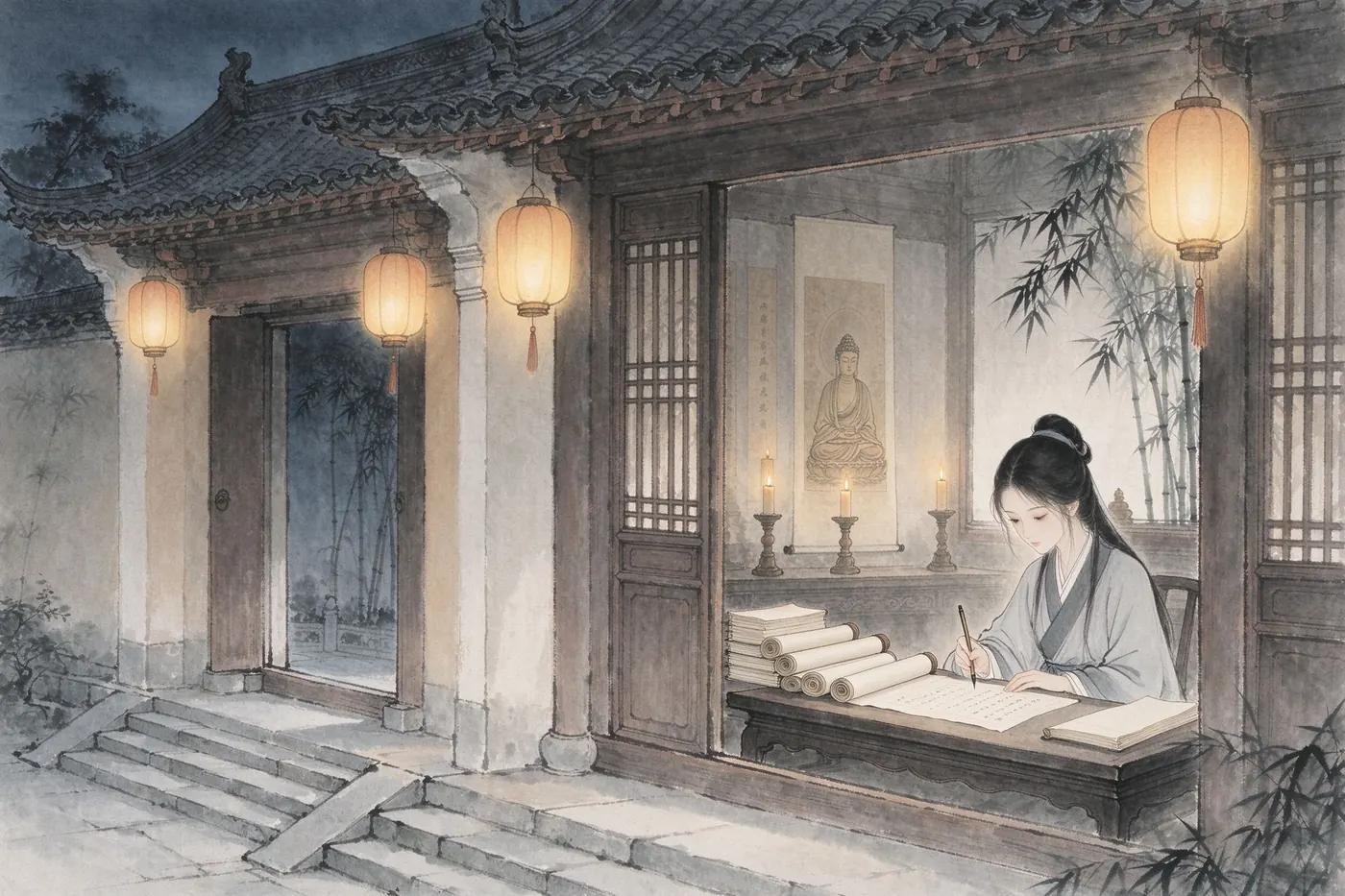
The day after the Lake God case was closed, the town was still clearing up the aftermath.
Boats were on the ferry crossing again, people on the dike again, and in the tea shed anything was talked of. Some said the Lake God had opened his eyes; some said the outsider had broken the curse; and in saying these things they all lowered their voices—the case was closed, but the thread-end behind the case had quietly stayed in every heart.
Shen Zhibai did not listen to such talk. He had risen before dawn and packed what they needed into a bundle: that old ledger, wrapped twice in oiled paper; a brush; a small ingot of silver; an umbrella. When Su Xuan arrived he had already stood a while at the ferry crossing, the dew underfoot soaking a thin film into his shoe-tops.
"Today is an incense day," she said. "Miss it, and we'd have to wait for the first of next month."
She hitched a cloth bundle higher in her arms. In the bundle was the ledger; she insisted on carrying it herself. Shen Zhibai glanced at the bundle and did not stop her—he knew stopping her was useless. This girl's will was stouter than a boat's hawser.
The boatman knew them now. He had seen with his own eyes the doings of the past two times, and this time asked nothing, only poled the boat toward the far bank, working the oar steady and slow. The morning mist had not yet lifted; the lake lay flat as a page with no writing on it. Two people in one boat, neither speaking. The oar-stroke, one after another, parted the water and let it close; the mist walked low along the water's skin, and reaching the boat's side made a gap, and closed again at the stern.
"The nunnery will be crowded," Su Xuan said suddenly. "Going like this, the two of us stand out too much."
"So don't look at the two of us," Shen Zhibai gazed at a hint of mountain shadow in the mist ahead. "Look at the nunnery. However many the people, the nunnery is dead matter—it won't pretend."
Su Xuan turned her head and glanced at him, and set this sentence down.
Ciyun Nunnery stood some ten-odd li west of the town, built against the hill. After leaving the boat they walked a little under half a shichen; the mountain road bent, and ahead it suddenly grew lively—
The flagstone road before the mountain gate stretched from the foot of the slope up to the top, no head to be seen ahead, no tail behind. Sedan chairs, mule carts, carrying-poles, pilgrims, packed a narrow mountain road to bursting. There were old women on canes, shifting forward step by step, the incense in their hands straighter than the women themselves; women carrying babes, the babe asleep in their arms while their lips still moved soundlessly, opening and closing, muttering who knew what; men bearing poles, with full bundles of paper horses and two strings of white-flour steamed buns, lowing a hawker's cry as they walked, and having cried half of it, finding no one to answer, swallowing back the second half themselves; and several ladies in silk, the hems of their damask skirts sweeping the dust, every one with lowered brows and downcast eyes, as though come to do a thing of the utmost urgency that could never be spoken of to others.
No one spoke aloud. Along the whole road there was but one kind of sound: the shush of cloth shoes over stone, and coughs rising and falling, pressed very low. Now and then a child who knew no better would cry out once and be at once clapped over the mouth by its mother, the cry stifled back into the throat and turned into a string of yet finer sobs.
At the roadside stood a great jar, crammed with incense, thick and thin, dense as a clump of dead bamboo. The incense smoke rushed straight up, and pressed down by the morning wind, poured full into people's faces, stinging their eyes shut. On the jar's rim rested a coarse-porcelain bowl with a chipped mouth, holding the lamp-oil money pilgrims had added—a few copper coins, half a bit of broken silver; who had added and how much, no one counted, no one recorded.
Shen Zhibai stopped before the jar and coughed once.
"This incense," he said, "burns thicker than the City God's temple in the county seat."
"More than that," Su Xuan said quietly. "Three years ago this was still a ruined nunnery."
She put out a hand and gestured vaguely at the mountain gate. The gate had been newly repaired—vermilion lacquer, gilt-capped studs, and even the steps all neat and trim, not a weed in sight. The plaque above the gate was gilded, its three great characters smoked by incense and lit by the sun, bright enough to dazzle the eye.
"Three years, three changes of plaque." She stared at the three characters, her voice dropping another pitch. "The one from the year before last had lost its lacquer at the right corner—I remember. Because that year my father kept an entry for the nunnery, 'plaque-silver'—forty-two taels. When he'd finished the entry, my father laid down his brush and said one thing: the nunnery's face is costlier than the nunnery's Bodhisattvas."
Shen Zhibai followed her gaze to the plaque. The gold looked like true gold, the characters newly drawn, not a single crack on the frame. He noted the figure in his mind: one plaque, forty-two taels; three times in three years, that was a hundred-odd taels. A country nunnery, a hundred-odd taels of silver, all spent on its face.
"Bookkeepers care for what's solid," he said. "A nunnery cares for its front. These aren't the doings of the same sort of people."
Su Xuan did not answer; she drew her gaze back from the plaque. The stream of people was shifting forward; the two went with the crowd into the gate.
Once past the gate, the incense smoke hung heavier still. In the open ground before the front hall, incense-and-candle stalls stood at separate tables, red-lacquered wooden tables ranged in a line, the incense and candles on them stacked like rice in a grain shop at the town's mouth. Shen Zhibai walked, watched, and counted—and when he counted things he did not look at people's faces, only at the objects at hand: incense-and-candle stalls, five tables in all; merit boxes standing left and right before the hall, four in all; the guest-receiving nuns in grey cloth jackets, split into three groups—one group collecting incense funds at the gate, one at the hall to guide the way, one going through the moon gate to the side court, to guide especially the ladies who came by sedan; sedans stopped at the third old locust tree outside the gate, and those who stepped down walked twenty-seven paces from alighting to crossing the gate, and those with more paces were all of bound feet.
Su Xuan at first did not notice what he was doing. She had eyes only for the road, and for those women with lowered brows and downcast eyes. The guest-receiving nun at the gate held a brass bowl to collect incense funds; pilgrims threw money in, more or less, and the nun did not so much as lift an eyelid, only pushing the bowl's mouth a little forward. A lady in silk dropped in a small bit of broken silver; the silver fell into the bowl without so much as a sound—a layer had already been laid along the bottom. Su Xuan's gaze rested on that bowl a breath: money goes in, uncounted; uncounted, there is no account.
As she was thinking this, the man beside her slowed half a step and stopped before a merit box.
"What is it?"
"The box is new," he said.
Su Xuan looked at the merit box as he said. The box was camphor wood, red-lacquered, gilt-drawn, with a small brass padlock hung on the hasp, the lock's face polished bright enough to mirror a person. She could see nothing special, and crouched to look at the box's bottom—the feet were clean, with hardly any dust. Then looking further out, on the grey-brick ground there were four shallow square marks, a ring larger than this box, and the grey brick inside the marks was of a deeper color, the trace left by an old box pressing there year in, year out.
The new box was a whole ring smaller than the old box's marks.
She crouched there a while, tapped her fingertip twice lightly on her knee, squared this "figure" in her mind, then stood and gave him a look. And in that look she suddenly found that the way this man looked at things was exactly the way she looked at accounts—first the bottom, then the surface; first the marks, then the box. When a figure in the accounts doesn't balance, an outsider can't tell; you have to turn back a page and check against the base. When a box here doesn't fit, an outsider can't tell either; you have to crouch down and check against the marks.
"The old box was large, the new box small." Shen Zhibai crouched and, half a step off, looked at the four square marks. "A small box is easier to lift and carry. What it holds, where it's carried—an outsider won't think twice."
"In your father's accounts," Shen Zhibai still eyed the box, "that column three years ago, 'incense funds'—it was blank?"
"Blank." Su Xuan's voice was very low. "Before three years ago the nunnery's incense was cold and thin; in a whole year it barely took in a few strings of cash, and that column in the accounts was simply left blank. After three years ago—"
She paused.
"After three years ago, suddenly it was full. So full—full past all reconciling."
The two exchanged a look, neither speaking.
Behind them the stream of people still pressed forward; from the front hall the sound of the wooden fish came through the incense smoke, stroke after stroke, not fast, not slow, like someone keeping time in the dark. An old woman squeezed past them, knelt on the meditation cushion before the merit box, kowtowed, made a vow, her voice broken beyond hearing. The incense smoke, mixed with the sweat-smell of bodies and the scent of incense on the sedan curtains, churned into one mass, stifling in the chest.
Shen Zhibai ranged these things in a row in his mind: the new plaque, the new box, the incense burned to its height, and the blank column of three years ago in Su Xuan's father's accounts. The four together were like a man who had suddenly grown a size fatter—others see only that he has grown fat, and say his days have improved, but do not know what he eats, nor at whose table he eats it of a night.
What is eaten must come from somewhere. What comes from an unknown place, more often than not, cannot bear the light.
"What have you seen?" Su Xuan asked quietly.
"This nunnery," he said, word by word, "doesn't look like a place of renunciates. It looks like a place well used to doing business."
Su Xuan did not answer.
She looked at the gilt-drawn new box, at the women queued before it with lowered brows and downcast eyes, and suddenly remembered two words A-Lian had said—
A price tag.
Those two words she had not taken to heart at the time. Now, standing before the hall where the incense stung the eyes, looking at these pilgrims who seemed come to do a thing of the utmost urgency that could never be spoken of to others, gooseflesh rose slowly on the back of her neck. So much money, and the accounts clean; so many people, and every face as if hiding something. This "business" in the nunnery—what exactly was its business?
Wind poured in from the direction of the mountain gate, sending the incense ash in the great jar spinning. She drew back her gaze and stood half a step closer to him.
"Let's go in and look," she said.
"Mm." Shen Zhibai switched the umbrella to his other hand. "Look from within the crowd."