Under the Lamp
Records Under the Lamp · Chapter 7 of 100
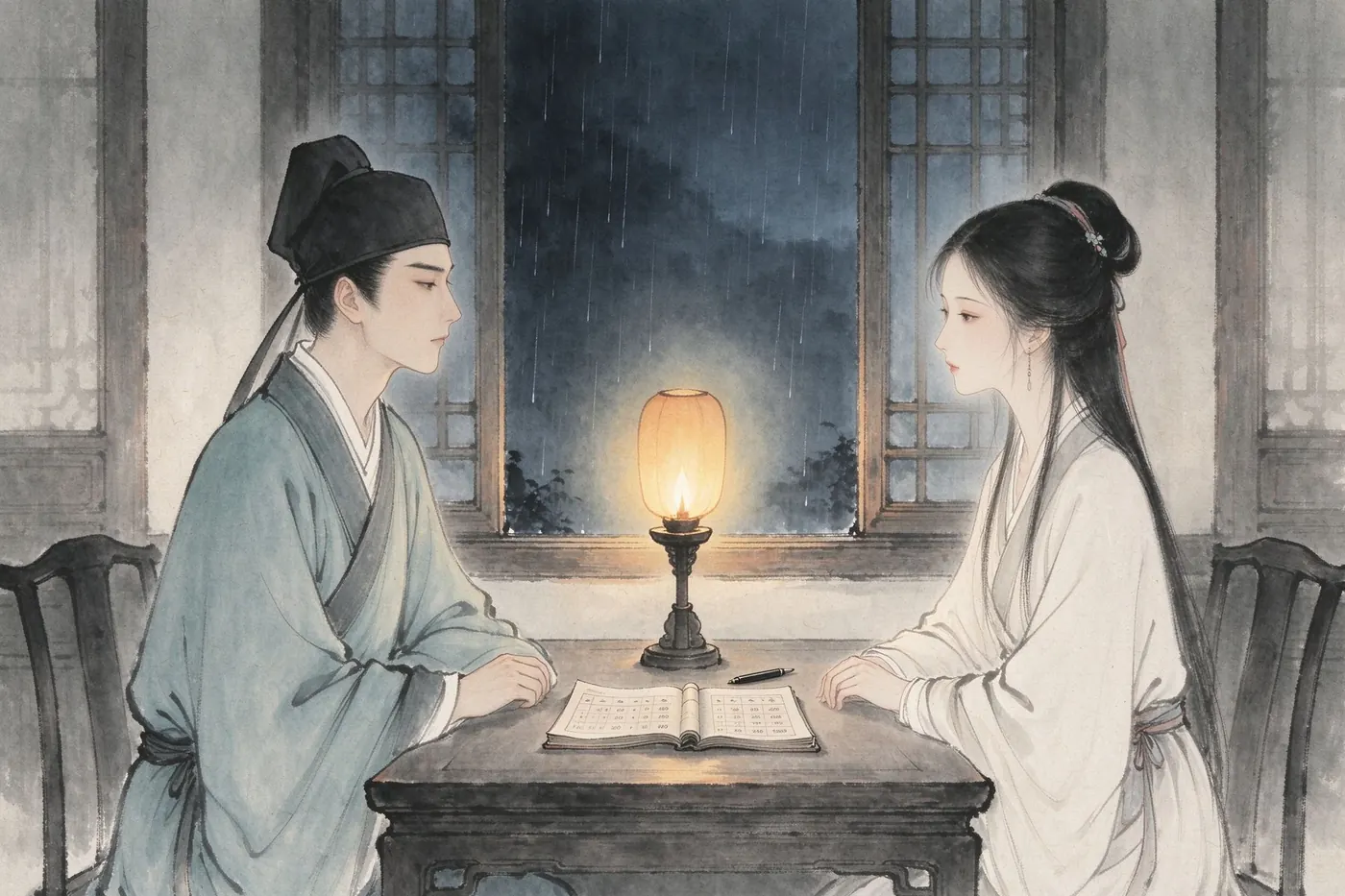
The boatman's house at the ferry crossing was not large—an inner room and an outer. The inner room had been given to the two women brought down from the Back Hill; the door-curtain hung low, and now and then the rustle of water came out—the boatman's old wife was washing and dressing their wounds. The outer room was crowded: the boatman, and two neighbours who had come to help at the news, squeezed together by the stove, all speaking in lowered voices, as if afraid of disturbing something.
On the table was a single lamp.
The wick was short, so the light was no more than a palm's width, just covering the tabletop. The rain was still falling, fine now, the gutter-water dripping, drop by drop, evenly, like someone plucking a very fine string on the tiles.
The boatman poked the stove-fire brighter and spoke in a low voice with the neighbours: that house on the Back Hill—should they report to the village head first thing in the morning? The neighbour said the village head probably knew already. The boatman said no more, and glanced at the lamp on the table—as if asking the two young people, and as if asking himself.
The ledger lay open on the table, the very one picked up from the house on the Back Hill. The paper had been soaked by damp, gone soft, the corners curled and frayed. Shen Zhibai pressed a page-corner with two fingers—without pressing, the paper would curl back on itself.
Su Xuan sat across from him.
She had been rained on all day; a strand of her hair still wet, stuck to her cheek; on her cool pale face there was little colour, but her eyes were bright. She read accounts fast; her eyes swept line by line, and in her mind she had already sorted them: this was when the person was sent, this the one who sent, this the money collected, this the entry the money was paid out from. Three years, from first to last, took no more than the time of a cup of tea.
"Incense funds." She spoke in a low voice. "When they were sent, who was sent, how much was collected, and to whom it was plainly given—entry by entry, recorded perfectly clear."
She turned the ledger around to show him. The writing was regular script, neat as a bookkeeper's hand. Even the days for sending people were chosen as "auspicious days"; even the ages of those women were noted after their names—sixteen, eighteen, seventeen.
Like goods, marked with their quality.
The laughable thing was that an account for sending people to their deaths should be kept so neatly too.
"Among the accounts I've audited," Su Xuan said in a low voice, "there are those short on labour, those altered and patched, those that bury a deficit in a dead debt. All of them look like the work of people." Her fingertip tapped the spine of the ledger. "This one—too clean. Too clean to be kept by a person."
Shen Zhibai did not answer at once. He read slowly; taking the ledger, he went from the first page, entry by entry, as if checking sums. His finger-pad moved across the paper, line by line; at a figure he silently pronounced it, then checked the next entry.
"That entry at the winter solstice—what was collected was white rice, converted to money?" he suddenly asked.
"Converted at the day's rice price." She answered without thinking. "I asked the price in town today; converted, the figure matches." She paused, then added, "The rice price I asked, but the price they set—how much to convert, that was not up to the one who sent."
The room was crowded, and there was only one lamp. The two of them leaned toward the lamp as if by tacit agreement.
At first there was still half a table between them. She called out figures, he checked them; she turned the page, he pressed the corner. At some point their shadows met first, layering thin on the tabletop, no telling which wisp was whose.
The damp still in her cuff, and the earthy smell of rain still on him, met too.
Reading the entry for "last year's winter solstice," their fingertips landed, one after the other, on the same figure.
His landed first—he was checking that line. Hers landed after—she read fast, had turned past it, and turned back, and stopped on that very cell.
The lamp flower crackled.
Neither drew their hand away first.
That bit of warmth passed across their fingertips, small, clear, hotter than the lamp. Her fingertip was cool—the cool of being rained on half the night; his knuckles had a thin callus, worn from years of the abacus, of twisting rope. Cool and hot pressed together, like a copper coin pressed to a red-hot iron, and neither felt they should withdraw first.
"This entry doesn't balance," she spoke first, her voice a little rough.
"I know," he said. "What comes in is a full tenth more than what goes out." He paused. "The extra tenth—where did it go?"
"It isn't written in the accounts."
"Not written means they don't want it seen."
Su Xuan grunted, yet did not draw her hand back.
She had read accounts for so many years. Cloth shops, rice shops, pawnshops—however tangled, once an account came into her hands, she gathered, matched, and balanced it, never one slip. Her peers said her eyes were an abacus in disguise, and she herself believed it. This was the first time she had ever been distracted—her eyes still on the paper, yet her mind full of that one cool point on her fingertip.
The cool was plainly hers. Yet the hot was also hers.
She used the turning of a page to draw her hand back, her fingertip pressing lightly on the table edge, as if to warm that coolness back. She had plainly sorted the whole ledger's figures just now, yet now, closing her eyes, her mind was blank, with only one figure left: of ten tenths, the extra tenth. The rest—not one entry could she recall.
This had never happened to her.
Unwilling, she closed her eyes again and ran the sums from the first entry. At the third line, an unrelated thought suddenly leapt up—when he read the figures just now, his voice was pressed very low, as if afraid of disturbing the names on the paper. The moment the thought appeared, the figures on the fourth line went to pieces. She opened her eyes, and simply stopped checking.
Shen Zhibai, too, was distracted. The same line he had read three times, and each time what he took in was four characters: no father, no brother.
"Miss Su."
"Mm."
"This tenth," he said, "I will find it."
"I know," she said. "Count me in."
Four words, light, yet like the last weight set on a scale.
She suddenly reached out and, by the lamp, turned this page back.
The previous page held a name from half a year ago; before that, from last winter. Three years, one a year, not one entry more, not one less, like the harvest from a field, like the offerings at a festival, picked by days, following the rules.
She turned to where the pages were joined and found a small length of red cord pasted there. The knot faced inward, tied in a clove hitch—the same way the rope had bound a person on the raft on the lake.
Her fingertip paused over that length of red cord and did not touch it.
"They didn't pick people at random," she suddenly said.
"How so?"
"Look here." She pointed at the small characters after the names, her fingertip hovering a cun above the paper without landing—if it landed, she feared touching his hand again. "Age, day, and 'kin.'" She read down, line by line, her voice dropping lower and lower. "No father. No brother. Widowed mother. Those chosen were all people no one would speak up for."
When she finished, the room was silent a moment. She straightened the ledger a little—the pages had gone crooked; she set them right as she passed, the movement light, as if straightening something for someone.
Shen Zhibai said nothing.
Under the lamp, those neat characters suddenly turned glaring. Every stroke seemed ground from bone: who was worth how much, whose family was of what standing, who had no one behind them. Written perfectly clear, not one miswritten character.
He wanted to say something—wanted to say people like these were easiest to pick, that reporting to the officials might not bring anyone, that this town's silence was a wall built by everyone together—and the words came to his lips and went back down. These words, spoken, were light; dropped, too heavy.
The medicine pot on the stove gurgled once. The boatman's old wife came out from the inner room to add water, and set two bowls of ginger broth at the corner of the table, glanced at the two young people leaning together under the lamp, said nothing, and went back in.
Su Xuan reached for the ginger broth, and Shen Zhibai happened to reach too. Their hands paused above the bowl's rim; this time she withdrew first—a little slow, her fingertip brushing the back of his fingers, cool, still cool.
"Hot," he said.
"I know," she said. Only as the words came out did she realize she had said "I know" twice already. She bowed her head and blew on the broth; the steam rose, a white film before her eyes.
Su Xuan raised her eyes.
And met his eyes, also raised.
Their gazes collided above the lamp flame, and at once both turned aside. She looked at the rain outside the window; he looked at the stove-fire, like two students caught in the act by a teacher—only neither was truly guilty, only too close, close enough that each could have counted the other's breaths.
"Keep the ledger with you," he said after a long while. "Tomorrow we'll still need it to check the figures. You look carefully."
"Slowly," she said.
"Slowly," he said, "is the only way not to lose that tenth."
He smiled, very briefly, swiftly gone, like another crackle of the lamp flower. This was the first time Su Xuan had seen him smile. She bowed her head and smoothed her half of the page-corner, smoothed it three times before it lay flat.
The lamp shortened, inch by inch. The rain lessened, inch by inch.
Shen Zhibai reached out and turned the wick up half a notch. The halo grew a little, and fell first on her side. He made the movement very casually, as if offhand, as if it should be so.
Su Xuan looked at that light falling first toward her, and did not thank him. She pushed the ledger toward the middle between them, and closed it halfway—only halfway.
Neither bowed their head to look at the accounts again.
The water-sound in the inner room stopped; the old wife blew out the little lamp within. By the stove, the neighbours dozed off, their snores pressed very low. The steam of the ginger broth dispersed wisp by wisp; a ring of tiny water-beads formed on the rim of the bowls.
The rain-sound was almost gone. The last drop on the eaves fell, and a long while passed before the second.
That page of accounts—no one turned it again.