Sudden Death
Records Under the Lamp · Chapter 8 of 100
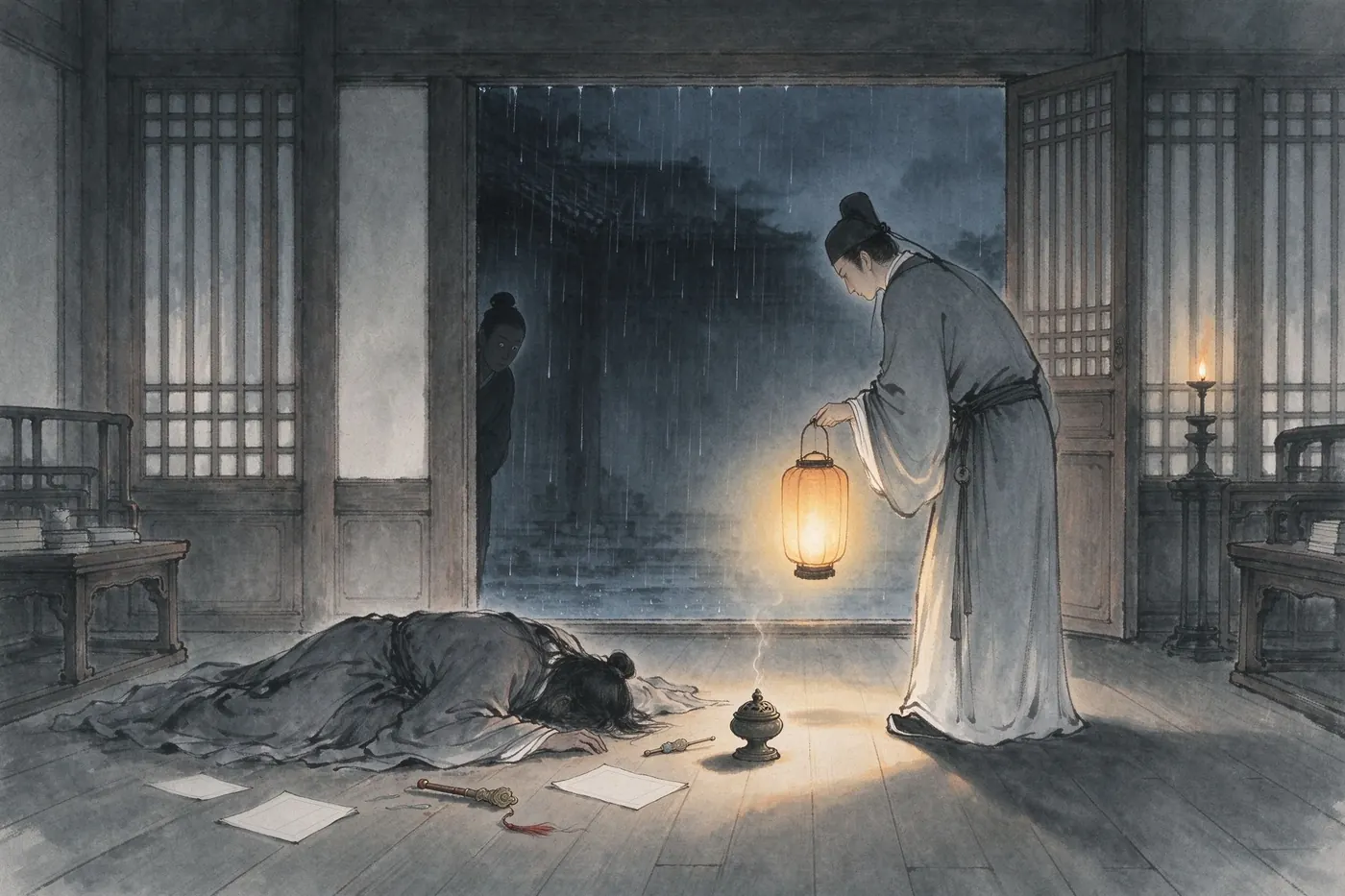
Hu Jiu died that very night.
No one in the town ever knew what happened in his room that night. People knew only that at first light, the page boy who delivered his wine came as usual with empty panniers to collect the bowls. He had done this errand more than a year, morning and evening, so familiar he could walk it with his eyes shut. At this hour on other days, Hu Jiu would long have risen—sitting at the door picking his teeth, or cursing him through the door-plank for coming late. This day, he called "Master Hu" three times outside and got no answer; three more times, still no answer. The room was unnaturally quiet; even the yellow dog that always lazed on the threshold was gone.
Muttering "drunk again," the page boy reached out and pushed; the door opened at a touch—unbarred.
First he smelled something. Sweet, cloying, like a night's soak in leftover wine-dregs with something meaty, sealed in the room all night, striking the brain until it swelled. Then he saw Hu Jiu sprawled over the table, face buried in the crook of his arm, the posture of a man asleep. The page boy leaned his wine-panniers by the door and went to pat his shoulder.
That pat left him helpless.
Hu Jiu slid down with the pat; the blood from his seven orifices had long congealed, black through, against that bluish-white face like a peeling judge-figure on a temple wall. On the table still stood a half-bowl of unfinished wine, a thin film on its surface, on the verge of breaking.
The page boy backed to the threshold, his legs gave, he sat down; a long while passed before he pulled out his first cry. When it came out, his voice was split, and he himself did not recognize it as his own.
That one cry woke half the town.
People came running through the mud and water. The room was small; those who could not squeeze in blocked the door, the windows, craning, peering; the chill after the rain mingled with the warmth of bodies, pouring into the room layer by layer.
Those who arrived first had looked at all they could: the window was barred from within, the wooden pin driven in tight, a thin layer of dust on it, plainly untouched; the door showed no prying marks, not even a white mark the size of a fingernail; the loose earth on the floor bore only Hu Jiu's own footprints, from threshold to table, and table to threshold—trampled askew by the frightened page boy. Beyond that, no second person's prints.
On the table the lamp had burned dry, the wick burnt to a short black stub. The lamp had gone out in the middle of the night.
Someone drew a cross on his chest, then quickly pulled his hand back into his sleeve—this was the Lake God's territory; no other god had business here.
No footprints, no prying marks, no second person.
A man, window barred, drinking his own wine, bleeding from all seven orifices, dead in his own room.
"This is divine punishment." No one knew who said it first, the voice trembling. "It's the Lake God... the Lake God has passed judgement."
This sentence was colder than the draft after rain; the whole room shivered together.
Word travels faster than people. In less than an hour, every lane in the town was talking of it. Said once in the tea shed, said again at the well platform, and as it went, everyone became an eyewitness; even how many times the half-bowl of wine by Hu Jiu's hand had sloshed as he fell was told with vivid particularity.
And as it was told, three versions emerged.
The first version said: the Lake God had manifested. Hu Jiu had served the god for three years, knew too much of the business he handled, and the god had taken him back. This version passed mostly among the old, and always in a low voice.
The second version said: this was retribution. When the first palanquin went out three years ago, he should have thought of this day. This version no one would say aloud, only whisper between close neighbours.
The third version came last but spread fastest—it was that outsider. The outsider had stopped the god's raft at the ferry crossing, offended the god; the god's wrath fell not on him but on the man who did his work for him. Hu Jiu had died in his place. This version was the easiest: it kept the words "divine punishment" intact, and gave everyone a sinner visible and within reach.
The three versions rolled through the streets for an hour, and in the end only the last remained.
The first two, people dared not believe; the last, they dared.
Shen Zhibai arrived with the flow of people.
He had gone out when he heard the stir in the boatman's house at the ferry. The rain had started again as he left, fine as mist; he stood in the flow of people and heard it all the way, understood seven or eight parts, and his brows had not once relaxed.
The area outside Hu Jiu's house was already packed. The village head, Wang De, had come early and stood in the doorway, directing a few able-bodied men to hold people back, not letting them push in—less to guard the scene than to guard that phrase "divine punishment." Catching sight of Shen Zhibai, his face darkened at once.
"Outsider." Wang De spoke, his voice pressed low and harsh. "A strange face. The one who died last night—that was him. Tell me, was it you?"
The crowd burst open with a roar.
"It's him!"
"It is! The one who stopped the raft at the ferry yesterday!"
"Outsiders, not a good one among them!"
Mud-spots flew with the spittle. Shen Zhibai neither argued nor raised a hand to wipe. Rain ran down his brow; he stood where he was, and first looked at every face in the yard, one by one—remembering which few were shouting, which few were shrinking.
Then he looked into the room—Hu Jiu had already been lifted onto a door-plank, covered with a straw mat, and under the mat a hand showed, the nails black-blue. He looked again at the half-bowl of wine on the table, the film on its surface still there, unmoving. At last he looked at the position of that table.
The table was set in the middle, with a bench on either side. Hu Jiu lay sprawled over the inner one; the one opposite, its seat was dry.
Opposite the table, there was another bowl.
Empty, not cleared away.
Something lurched in his chest.
Then he spoke suddenly, his voice not loud, yet able to override the clamour of the whole yard: "When he died, who saw him? Who brought him wine?"
The crowd went quiet a moment.
The question was asked out of nowhere; the crowd looked at one another, and not one answered. Those who had been shouting loudest just now pulled in their necks and lowered their heads. Only the page boy, holding the door frame, moved his lips, and in the end made no sound.
Shen Zhibai took in the silence of the whole room and asked no more. He parted the crowd, crouched down, and looked at the wine.
A little less than half remained. He brought his face near and sniffed; his brows knotted tight—beneath the wine-smell lay a very faint bitterness, wrapped in the sweet cloying smell of the dregs, indistinguishable unless closely examined. The film on the wine caught the daylight, dark.
Then he looked at Hu Jiu's hands. The nails black-blue, every one, black to the root; yet the fingertips gripped the table edge, five fingers dug into the wood's seam, as if in dying he had clutched at something and feared it would escape. At the seam's edge, a few fresh slivers had been scraped off, white and bare.
At the table's corner, there also lay a small thread-end of cloth.
Grey. Coarse cloth, loosely twined, not the colour of the dharma robe Hu Jiu wore—his dharma robe was dark blue, and he had been wearing it this morning.
Shen Zhibai reached out two fingers, picked up the thread-end, and brought it before his eyes. The thread was very short, the break clean, snagged off a garment. He held it and looked at it by the daylight at the door, then tilted his head to look at his own warped reflection on the half-bowl of wine.
Then he put it back where it was.
Take it away, and the thing was gone; leave it in place, and it was still "it."
He rose, brushed the earth from his hands, his voice very level: "Last night, he drank with someone. That person left and also took away the other bowl—but took it untidily."
The crowd was stunned a moment, then someone shouted: "Who says he drank with someone?! Master Hu's room—no one dared come near it all night!"
"On this table there was originally a pair of bowls." Shen Zhibai raised a hand and pointed at the tabletop. "One is here; one is gone."
Following his finger, everyone saw: on the table the empty bowl sat alone, an old chip in its rim; and the bowl holding the remaining wine did not match it—two bowls, different patterns, one large, one small.
The crowd hummed and fell to talking.
"Someone really did come..."
"But the door wasn't pried, the window was barred—how did the person get in? And how did he get out?"
"Could it be... could it really be the god?"
"Would a god need to sneakily take away a bowl?!"
Once the talk started it would not stop. Wang De's face changed again and again, and he flung his hand: "Everyone shut up! What nonsense are you babbling?"
Shen Zhibai looked around, and suddenly understood.
From the first cry this morning, to the three versions rolling through the whole town, to this yardful of people all biting on the words "outsider"—this case wanted a murderer, and wanted him in a hurry.
And an outsider was the most convenient.
He said no more and withdrew from the crowd.
No one stopped him. Those who a moment ago had spat at him now looked at him differently, like a thing of uncertain fortune or disaster, and unconsciously opened a way for him.
Rain-threads fell on his face, cool. Shen Zhibai stood in the middle of the street and looked back once at that house: figures wavered on the window-paper; Wang De was loudly issuing orders within; not a word came clear.
He thought of the night before, under the lamp, that soaked-soft ledger. Of the winter-solstice entry, page-corner curled, pressed flat by a hand. Of someone saying "I know," twice—the second lighter than the first.
That lightness, once heard, he had remembered.
That half-account now lay in an oilcloth wrap, pressed at the very bottom of his bundle.
He cinched the bundle higher on his shoulder and stepped out, toward the ferry crossing.
From today, this thing must be watched closely—not for its own sake, but for the pair of eyes that watched it. Numbers do not cry out for justice, but people do. And this town, so eager to find a murderer, would not be the only one eager to find him.